A blog about my culinary experiences in Paris and around the world.
Showing posts with label Paris districts: 11eme. Show all posts

Sunday, February 27, 2011

Rino

Rino (pronounced Reeno by Parisians) has been getting rave reviews by food critics, bloggers and the like grading it 4/5 and calling the Chef an Italo-French genius. It's part of the new wave of bistronomies taking over Paris (alongside Inaki Aizpitarte's Chateaubriand, Gregory Marchand's Frenchie and Daniel Rose's Spring). 


But what is Bistronomy?
Gary Lee Kraut explains that bistronomy is a combination of bistro and gastronomy. After classic training at some of the city's most prestigious establishments, a number of young chefs have struck out on their own with modest daily market menus made from fresh, hand-chosen produce. Fed up with the Michelin star rat race, they have sparked what some have termed the most influential culinary trend in a decade. These are indeed bistros since the additional elements required of a truly gastronomic restaurant—elegant services, fine tableware, more expensive produce, a section-by-section kitchen staff, a decorator—may be absent.


A number of famous mid-career and older chefs who have made their name in gastronomy now have an adjacent business of bistronomy including Christian Constant and Yves Camdeborde. 
Perhaps that the whole bistronomy idea is a marketing ploy used by the chef/owner who claims that his restaurant is just above the ordinary bistro. In any case, these types of bistros are inviting, relaxed and produce well-thought out meals in an unpretentious setting at an affordable price. 

Rino encompasses this very idea. A pocket-size restaurant in the 11th district, the restaurant welcomes around 20 covers with a few high tables overlooking the kitchen at the front, and a more intimate setting with closely fitted wooden tables in the back with red banquettes. The decor is minimal: white painted walls, a few vases of tulips here and there and ordinary lighting. 


The staff is Italian, the waiters explain the menu in his Italo-French accent to you on a blackboard that changes every day. The prix-fixe menu is fairly straightforward: 4 courses for 38 euros or 6 courses for 55 euros. No consumer choice here, the menu is at the discretion of the Chef. The other waitress asks if you want to start off with an aperitif - Prosecco is what they serve...no Kir here. 

Italo-born Giovanni Passerini runs the kitchen. Self-taught and a late bloomer in the culinary world, he started his career in a Michelin-star French restaurant (in Germany!) before heading back to Paris for a stint at L'Arpège, Chateaubriand and La Gazzetta. 

The wine menu is presented upon sitting at the table and covers more Italian than French wines price affordably in the 20-30 euro range. Like Chauteabriand, it's printed on several A4 papers clipped together giving the restaurant a laxed vibe. 


On the menu last night:


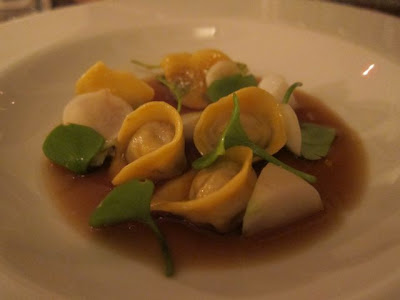
Entrée: Head of pork tortellini, crayfish consommé and turnip


Pouring the consommé


I thought the presentation was simple and elegant but lacked color. The consommé was very fine, you could actually taste crayfish and nothing else. I enjoyed the softness and the moistness of the tortellini with head of pork (though the taste was not very strong) mixed with the crunchyness of the turnip. I would have liked a bit more consommé as it was hard to spoon out the remaining drops. But one main concern and coincidentally my Mother's pet-peeve: if you're going to serve a hot liquid whether coffee, tea or soup - make sure it's hot, warm is passable; but this was rather on the cold side. 

I personally didn't think the meal got off on a good start. 

Poisson: Monkfish, watercress, cabbages and olive tapenade


This dish was more enjoyable with stronger tastes: the saltyness of the tapenade, the sweetness of the cabbages and the quinoa and the freshness and moistness of the monkfish - which I welcome with open arms because the monkfish I usually eat is quite chewy and tough. Again, it could have been served hot. 

I don't know if it was the light Southern white wine that made the dinner pleasant, but I felt the more I went along the menu, the better it got.

Viande: Milk-fed lamb, chicory endive, monkfish liver and onions


I loved the colors of the different ingredients on the plate: Red, green, orange and pink. The lamb was cooked rosé, just as it should be. I was a bit wary about the monkfish liver but there was only four drops of it on the dish so as not to overpower the sweet lamb. The onions were could have perhaps been cooked but I enjoyed their crunchyness and surprisingly subtle pickled taste. I thought this was the best dish so far.

Dessert: Citrus salad, dried fruits, semifreddo of bergamot. 


The first time I saw an Italian word on the menu. Looking at the menu, I wasn't too excited about dessert - fruits and frozen mousse? But I immediately took that back once I tasted it. The semifreddo was sour and matched well with the sweetness of the oranges and dried dates, and the crunchyness of caramelized nuts. The waiter saw that I liked it so much, he gave me a second serving - how observant!

I felt the Mediterranean influence of the Chef come through the market-based menu. The flavors were clean, the dishes combined a variety of ingredients. My experience got better and was much better than I expected after I had my first dish. Would I go back again? Sure, it's a market-based menu, it changes daily...Would I rather go to Chateaubriand or Spring (also serving market-based menus) with a more upbeat environment? Yes.

Rino
46 Rue Trousseau, 75011
Metro: Ledru-Rollin (Ligne 8)
Website: www.rino-restaurant.com
- Closed Sundays and Mondays

Saturday, February 26, 2011

Philou


Formerly of Le Square Trousseau (pre-Costes brothers) and Le Crillon Hotel, Chef Philippe Damas opened Philou, a restaurant in the 11th arrondissement between the Canal Saint-Martin and the Hopital Saint-Louis. 


Finding a good bistro in Paris is not hard, but Paris by Mouth named it the best value of Paris 2011 - must mean a lot . The service is friendly (there were about 2 attentive waiters and the chef popping in and out of the kitchen). The decor is very modern; the menu is written on the blackboard (it apparently changes daily), a little round bar at the entrance and a cool Ingo Maurer lighting fixture brightening the room. In the summer, I'm sure the large terrace outside will be very pleasant. 


Entrées:


Foie gras de Canard, pain d'épices et salade d'haricots verts
Duck foie gras, cinnamon bread and green bean salad


It was mi-cuit, silky and smooth. 


Poêlée de cuisses de grenouille et pleurotes à la truffe
Pan-fried frog leg with pleurotes mushrooms with truffle sauce


The pile of pleurotes with truffles didn't hurt as it soaked up the flavor of the frog leg and added a nice golden color to the plate 


Plats:


Rognon de veau et boulangère de céléri
Veal kidneys with celery


Perfectly cooked and rosé, it had a little gamey taste to it which was pleasant. The celery was tender, sweet and soft. 


Faux filet, grenailles et champignons
Faux-filet steak, baby potatoes and mushrooms


Nicely saignant, the roasted potatoes added crunch. 


Gelée de clémentines et riz au lait 
Clementines gelée and rice pudding


Here you'll find classic French cuisine renewed with fresh seasonal ingredients and serving natural wines for not much money. 15 - 30 euros for 1-3 courses. Thank god!


Philou
12 avenue Richerand, 75011
Tel: 01 42 38 00 12
Metro: Goncourt (Ligne 11)

Sunday, February 6, 2011

Le Dauphin


We're back with more news on Chef Inaki Aizpitarte, who to some is a culinary genius and an up-and-coming Chef on the Parisian food scene, while others think it's just all overrated. 

I'm not an adoring fan of Chef Inaki but his cooking is good. 

I've blogged about the Chef previously, after my visit to Chateaubriand about 3 months ago. I was very impressed at first but having eaten there a couple of times; some of the dishes became less memorable - perhaps that's where the mixed reviews of the restaurant come from? But the food is nonetheless good, moving Inaki's restaurant to 11th in Restaurant Magazine's World's 50 Best Restaurant List and beating culinary giants such as Gagnaire, Robuchon and Troisgros. 


Last night though, I spent an evening at Le Dauphin, his most recent venture a few doors down from Le Chateaubriand. It looks like a Parisian tabac from the outside; very uninteresting place to be honest but made a total makeover with Dutch architect Rem Koolhaas who magnificently transformed it into a modern Carrara-marbled wine bar serving more than tapas-like plates with natural wines from France. There's marble everywhere (the floor, the walls, the ceiling! The place is sleek, the decor minimal (but much nicer looking than Le Chateaubriand) and some dining tables laid out around the wine bar. Like Le Chateaubriand, the menu is a single sheet of A4 paper with a list of dishes that they serve - apparently it changes weekly. It's simple, nothing overdone - just what you need to know really. 


Mirrored walls in the back leading to the kitchen


I made a reservation for 7.45 pm, which was quite early, but the place immediately got packed by 8.30 pm with people typically at the wine bar (it is a wine bar in the end). I think when there was an initial buzz, it was hard to get a reservation but now not so much + it might just be worth walking in to have a glass of wine or two and munch on 2-3 dishes. 

As for the wine list, there's a variety of natural wines from France including Bordeaux and Burgundy but it leans toward the Loire Valley and promotes natural wine producers that I enjoyed at Le Chateaubriand as well; reasonably priced at 5 euros per glass and around 30 euros per bottle. 

We should be clear that the portions are not tapas-style like in San Sebastian, Spain, they are a little larger, more generous and I can't really pinpoint exactly the 'type' of food he serves - it's eclectic: French, Spanish, Japanese - kinda of like Chateaubriand where Inaki twists traditional dishes such as pig's feet, steak tartare by bringing out the original and base flavors of the dish - not overpowering it with other accompanying ingredients. 

However, unfortunately, I found there to be a lack of salt in the dishes - perhaps purposely done to accentuate the original taste? I do like a lot of salt...I was overall more impressed with this restaurant than Chateaubriand, it's something different and the food choice was more interesting - it was from the carte (whereas Chateaubriand is a prix-fixe for 50 euros). The prices of the dishes were reasonable for Parisian standards; between 8 - 10 euros, but serve this in Spain, I'd think he'd go out of business. 

Terrine de Foie Gras


Pluma Iberico, Radicchio (Pork fillet served crispy on the outside and rare...yes rare on the inside) - very impressive


Encornets a la plancha (Fried squid)


Eperlan en Friture (Deep-fried Smelt fish)


Poulpe Tandoori (Tandoori Octopus)


Steak tartare - hand cut steak with capers, fresh herbs and radish


Cochon de Lait Bigorre (Suckling Pig with Celery puree)


Along with the Pluma, the suckling pig stood out as the most flavorful dish, though I wished that the skin had a little bit more crisp to it. 


If you're willing to make the trek to the 11th arrondissement, definitely come here for a glass of natural wine or two and chow down on some good portioned tapas from Inaki Aizpitarte's new venture which holds already a lot of recognition at reasonable prices - so come before they increase! 

Le Dauphin 
131, Avenue Parmentier, 75011
Metro: Goncourt (Ligne 11)
Tel: 01 48 06 58 41


Tuesday, January 25, 2011

Bistrot Paul Bert


I have heard a lot about Bistrot Paul Bert as many's favorites for traditional french food. There's good reason for that. The menu changes seasonally and it's a carnivore's paradise (including yours truly) including hure de cochon, côte de porc, entrecôte, steak aux poivres among others. 


The restaurant is rather rustic looking, a traditional French bistrot to be honest with mirrored walls, tiled floors, and mobile chalkboard menus.  The tables are quite close to each other (as they are in Paris) and the menu is heavy on the meat. They have a lot of fish too, and they were equally as good. 


Entrées

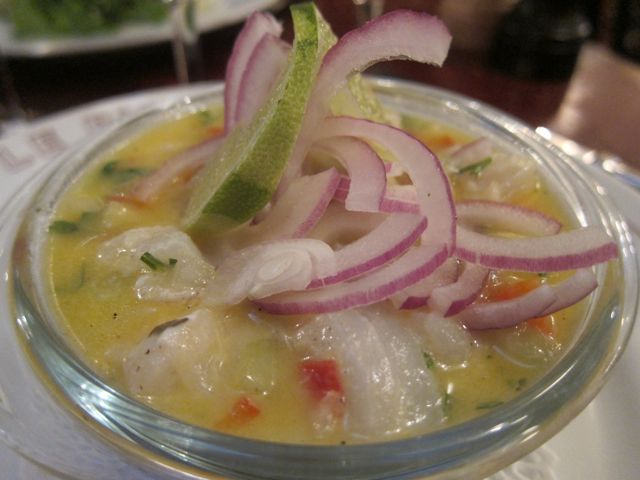
Ceviche de Cabillaud


Oeufs durs à la Mayonnaise de Truffe Noire


Plats

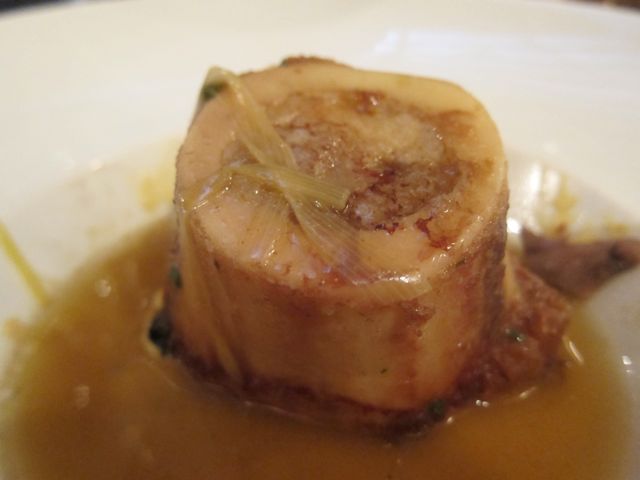
Pot-au-feu et ses légumes -  full of tender beef, potatoes, turnips, leeks, carrots, and even a fist-sized piece of marrow


This crowded and very popular place has become one of my favorite bistros in Paris as they serve an excellent entrecôte (served only bleue or saignante - as it should be but definitely not for the faint of heart) and frites. 


Desserts (if you still have room!)

Sorbets faits maison (ananas - pineapple, citron - lemon, cassis)


Soufflé au Grand Marnier


A must-come even if you're in Paris for 72 hours. It demonstrates traditional French cuisine done very well and will make you visit the East of Paris.


Two helpful suggestions: 1. Come with a big appetite, 2. Reservations strongly advised


Bistrot Paul Bert
18 rue Paul Bert, 75011
Tel: 01 43 72 24 01Metro: Faidherbe-Chaligny (Ligne 8)